More Problems
Problem 1:
Small spheres of radius "r" are incident with velocity v on a stationary hard sphere of radius "R" and scatter elastically. What is the total scattering cross section?
Solution:
- Concepts:
Definition of the scattering cross section, geometry - Reasoning:
The concept of cross section, as its name suggests, is that of effective area for collision. The cross section of a spherical target of radius R for point particles is σ = πR2. If the scattering particles have radius r, then the cross section is σ = π(r+R)2.

Problem 2:
Consider a uniform disc with mass m and radius a that has a massless string wrapped around it with one end attached to a fixed support and allowed to fall with the string unwinding as it falls, as shown in the figure.
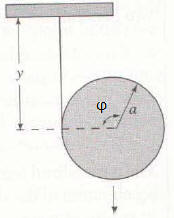
Use y and φ as the generalized coordinates to describe the system. Find the equations of motion for y and of the falling disc and the forces of constraint using the method of Lagrange multipliers.
Solution:
- Concepts:
Lagrange's Equations, Lagrange multipliers
d/dt(∂L/∂(dqk/dt)) - ∂L/∂qk = ∑lλlalk, Σk alk dqk + alt dt = 0. - Reasoning:
The problem requires us to use the method of Lagrange multipliers.
The coordinate y denotes the distance the CM of the disk has fallen, the coordinate φ denotes the angle through which the disk has rotated.
Then L = m(dy/dt)2/2 + I(dφ/dt)2/2 + mgy.
For the disk I = Ma2/2.
The equation of constraint is y = aφ, dy = adφ, dy - adφ = 0.
There is only one equation of constraint, so we can drop the index k.
ay = 1, aφ = -a, - Details of the calculations:
The equations of motion are
md2y/dt2 - mg = λ,
Id2φ/dt2 = -aλ.
dy - adφ = 0.
Solving these 3 equations we obtain
(m + I/a2)d2y/dt2 = mg.
d2y/dt2 = mg/(m + 0.5m) = 2g/3.
Qy = λ = -mg/3 is the force of constraint acting on m in the y-direction, it is the tension in the string pulling upwards on m. The minus sign indicates that the force of constraint is acting upwards.
Qφ = -aλ = mga/3 is the torque acting on the disk. It is the generalized force of constraint associated with the coordinate φ. The torque is pointing into the page.
Problem 3:
A uniform hoop of mass m and radius r rolls without slipping on a fixed cylinder of radius R as shown in the figure. The only external force is that of gravity. If the hoop starts rolling from rest on top of the big cylinder, find, by the method of Lagrange multipliers, the point at which the hoop falls off the cylinder.

Solution:
- Concepts:
Lagrange multipliers - Reasoning:
The Lagrange multiplier technique yields the radial force of constraint. The contact between the hoop and the cylinder will be lost when the radial force of constraint changes sign. The cylinder cannot pull. - Details of the calculation:
To find the radial force of constraint, we let R, θ1 and θ2 be the generalized coordinates.
They are connected by constraints of the form Σk alk dqk + alt dt = 0.
We have two equations of constraint.
R = R1, dR = 0, therefore we can choose a1R = 1, a1θ1 = a1θ2 = 0.
(We use R1 for the radius of the fixed sphere, to distinguish from the generalized coordinate R.)
dθ2 = dθ1(R + r)/r, therefore we can choose a2R = 0, a2θ1 = 1, a2θ2 = -r/(R + r).
(Note: θ2 ≠ θ1(R + r)/r until R is fixed. If we let R be a coordinate then we only have a constraint equation connecting the differentials of the coordinates.)
The three equations of motion are
d/dt(∂L/∂(dqk/dt)) - ∂L/∂qk = ∑lλlalk,
which have to be solve together with the two equations of constraint.
We have five equations and five unknowns, R(t), θ1(t), θ2(t), λ1 and λ2.
T = ½m(r + R)2(dθ1/dt)2 + ½mr2(dθ2/dt)2 + ½m(dR/dt)2. U = mg(r + R)cosθ1.
L = T - U.
∂L/∂(dR/dt) = mdR/dt, d/dt(∂L/∂(dR/dt)) = md2R/dt2,
∂L/∂R = m(r + R)(dθ1/dt)2 - mgcosθ1.
d/dt(∂L/∂(dR/dt)) - ∂L/∂R = λ1a1R + λ2a2R
(1) md2R/dt2 - m(r + R)(dθ1/dt)2 + mgcosθ1 = λ1,
∂L/∂(dθ1/dt) = m(r + R)2(dθ1/dt),
d/dt(∂L/∂(dθ1/dt)) = m(r + R)2d2θ1/dt2 + 2m(r + R)(dθ1/dt)(dR/dt),
∂L/∂θ1 = mg(r + R)sinθ1.
d/dt(∂L/∂(dθ1/dt)) - ∂L/∂θ1 = λ1a1θ1 + λ2a2θ1,
(2) m(r + R)2d2θ1/dt2 + 2m(r + R)(dθ1/dt)(dR/dt) - mg(r + R)sinθ1 = λ2.
∂L/∂(dθ2/dt) = mr2(dθ2/dt),
d/dt(∂L/∂(dθ2/dt)) = mr2d2θ2/dt2,
∂L/∂θ2 = 0.
d/dt(∂L/∂(dθ2/dt)) - ∂L/∂θ2 = λ1a1θ2 + λ2a2θ2,
(3) mr2d2θ2/dt2 = -λ2r/(r + R).
Constraints:
dR/dt = 0 --> d2R/dt2 = 0, r = R1.
dθ2 = dθ1(R + r)/r --> d2θ2/dt2 = ((R1 + r)/r)d2θ1/dt2.
Therefore
from (1): -m(r + R1)(dθ1/dt)2 + mgcosθ1 = λ1.
from (2): m(r + R1)2d2θ1/dt2 - mg(r + R1)sinθ1 = λ2.
from (3): md2θ1/dt2 = -λ2/(r + R1)2.
Combining the last two equations we have
2m(r + R1)2d2θ1/dt2 - mg(r + R1)sinθ1 = 0.
Contact is lost when λ1 = 0. (The normal force cannot pull.)
Then dθ1/dt = [gcosθ1/(r + R1)]½.
To find dθ1/dt as a function of θ1 we need to solve the differential equation
2m(r + R1)2d2θ1/dt2 - mg(r + R1)sinθ1 = 0,
or
d2θ1/dt2 = gsinθ1/(2(r + R1))
for dθ1/dt.
Denote dθ1/dt = f(θ1).
df(θ1)/dt = [df(θ1)/dθ1]f(θ1) = ½df2(θ1)/dθ1 = gsinθ1/(2(r + R1)) .
f2(θ1) = A - (g/(r + R1))cosθ1.
dθ1/dt = [A - (g/(r + R1))cosθ1]½.
Initial conditions: dθ1/dt = 0 for θ1 = 0, A = g/(r + R1).
dθ1/dt = [g/(r + R1) - g cosθ1/(r + R1)]½.
The hoop falls off when gcosθ1/(r + R1) = g/(r + R1) - gcosθ1/(r + R1),
cosθ1 = (1 - cosθ1),
or cosθ1 = ½, θ1 = 60o.
Comments: (not part of the asked for solution)
Finding λ1:
-m(r + R1)(dθ1/dt)2 + mgcosθ1 = λ1.
-m(r + R1)[(g/(r + R1) - gcosθ1/(r + R1)] + mgcosθ1 = λ1.
mg(2cosθ1 - 1) = λ1.
λ1a1r = Fr, Fr = mg(2cosθ1 - 1) is the reaction (normal) force of the cylinder on the hoop.
Finding λ2:
md2θ1/dt2 = -λ2/(r + R1)2.
m[g/(2(r + R1))sinθ1] = -λ2/(r + R1).2
mg sinθ/2 = -λ2/(r + R1).
What is the significance of λ2?
mr2d2θ2/dt2 = -λ2r/(r + R1)2.
-λ2r/(r + R1)2 = mgr sinθ1/2 is the generalized force associated with the coordinate θ2. Since θ2 is an angle, the generalized force is a torque. Rolling implies static friction. The force of static friction exerts a torque about the center of the hoop.
mgr sinθ1/2 = τθ2.
Note: The λs are not unique, but the formalism yields unique generalized forces of constraint.